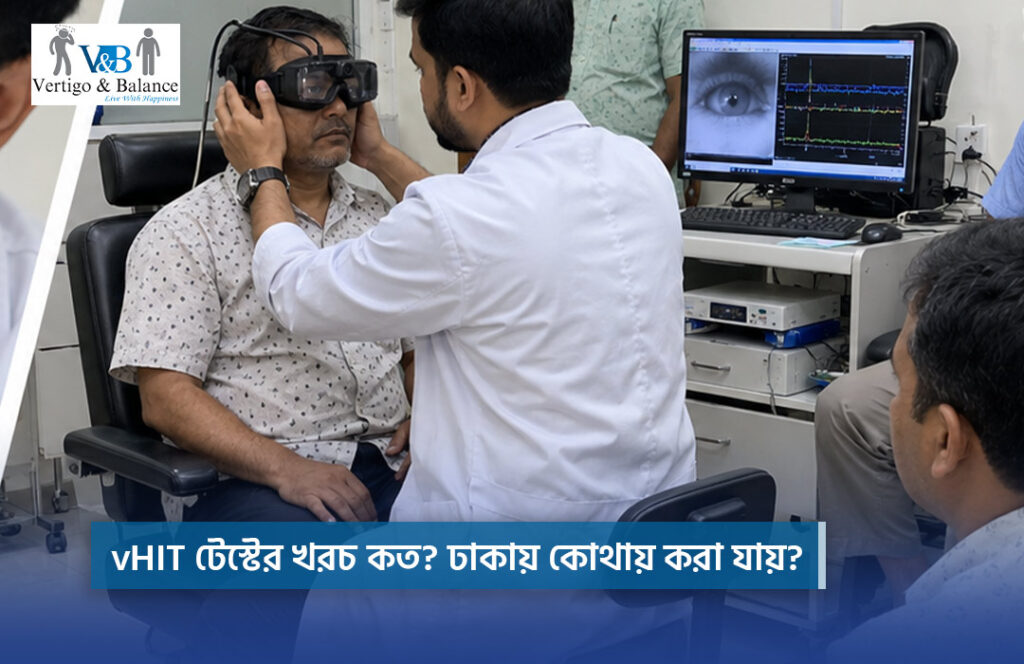
The video Head Impulse Test (vHIT) is one of the most advanced vestibular diagnostic tests now available in Dhaka. At Vertigo & Balance Center, vHIT helps our specialists objectively measure how well your vestibulo-ocular reflex (VOR) is working — a key step in diagnosing the cause of vertigo, dizziness, and balance disorders. If you’re searching for a reliable vHIT test in Dhaka, this page explains exactly what the test involves and what it can reveal about your vestibular health.

MINUTES
CANALS TESTED
Goggles NON-INVASIVE
The video Head Impulse Test (vHIT) is a modern, objective vestibular function test used to assess the function of the semicircular canals and the vestibulo-ocular reflex (VOR). The test evaluates how effectively the eyes maintain visual fixation during rapid, passive head movements.
vHIT allows assessment of all six semicircular canals individually and provides real-time, quantitative information about vestibular function. It is widely used in the evaluation of vertigo, dizziness, imbalance, and gaze instability.
The vHIT is performed to:
Unlike traditional tests, vHIT evaluates vestibular function under physiological head movement conditions.
The semicircular canals detect angular head movements and send signals to the brainstem, which generates compensatory eye movements through the vestibulo-ocular reflex. This reflex ensures stable vision during head motion.
In normal vestibular function, eye velocity matches head velocity, keeping vision clear. When vestibular input is reduced or absent, eye movement becomes insufficient, resulting in corrective eye movements known as saccades.
The vHIT records both head and eye movements using high-speed video, allowing precise measurement of VOR gain and detection of overt or covert saccades.
Acute or chronic vertigo
Dizziness with head movement
Suspected vestibular neuritis
Bilateral vestibular loss
Post-concussion dizziness
Follow-up of vestibular rehabilitation
The vHIT is a safe, non-invasive, and radiation-free test. Head movements are brief and within normal physiological range. The test can be stopped immediately if the patient feels discomfort.
The test is brief, non-invasive, and well tolerated by most patients
These parameters provide objective evidence of vestibular function or dysfunction.
• Requires patient cooperation and adequate neck mobility
• Goggle slippage may affect data quality
• Does not directly assess otolith function
• Should be interpreted alongside other vestibular tests
vHIT results must always be correlated with clinical findings.
Normal vHIT: VOR gain within accepted limits and absence of pathological saccades.
Abnormal vHIT: Reduced VOR gain with corrective saccades.
Typical interpretations:
vHIT provides objective, quantitative information about semicircular canal function. Results are intended for clinical interpretation by trained professionals and should be considered as part of a comprehensive vestibular assessment.
Clinical Use: Diagnostic Evaluation and Rehabilitation Monitoring
No. vHIT is completely non-invasive and painless. Patients wear lightweight goggles while the examiner performs brief, gentle head movements.
The test itself typically takes just a few minutes per side, though the full appointment including setup and calibration may take longer.
The vHIT (Video Head Impulse Test) cost in Dhaka usually ranges from ৳2,000 to ৳5,000, depending on the diagnostic center, equipment, and specialist consultation. For the exact price, it is best to contact the clinic or diagnostic center before booking the test.
vHIT identifies whether your semicircular canals and VOR are functioning normally. It’s one part of a full vestibular workup — your specialist will combine it with your history and other tests to reach a diagnosis.
vHIT should always be performed and interpreted by a trained vestibular professional, since results need clinical correlation.
Vestibular assessments performed
Dedicated diagnostic test modalities
BMDC-registered vestibular specialists
Established-Concept Tower, Panthapath
Vestibular Specialist & Neurotologist BMDC Reg. 65718-Founder & Chief Consultant
Vestibular Rehabilitation Specialist BMDC Reg. A-105382-AIB-Certified, VRT Center Lead
Trained Vestibular Professional
Diagnostic Evaluation and Treatment Planning