
If the room suddenly feels like it’s spinning, or you feel like you’re swaying even while standing still, you’re not alone. Vertigo is one of the most common reasons people visit a doctor in Dhaka, yet it’s also one of the most misunderstood conditions — because “dizziness” can come from dozens of different causes. Getting the right diagnosis starts with the right test.
In this guide, we’ll walk through the most effective tests for vertigo, when each one is used, and how proper diagnosis leads to faster, safer treatment.
Why Testing for Vertigo Matters
Vertigo isn’t a disease on its own — it’s a symptom. It can come from the inner ear, the brain, blood pressure changes, medications, or even anxiety. Because the causes are so different, a generic “you have vertigo” diagnosis isn’t enough. Without proper testing, patients often end up on medication that treats the symptom but not the actual cause, and the dizziness keeps coming back.
If you’re still wondering whether what you’re experiencing is even vertigo, it helps to first understand what vertigo actually means and how it differs from general lightheadedness. Once that’s clear, testing becomes the next logical step.
The Most Common and Effective Tests for Vertigo
1. Dix-Hallpike Test (Gold Standard for BPPV)
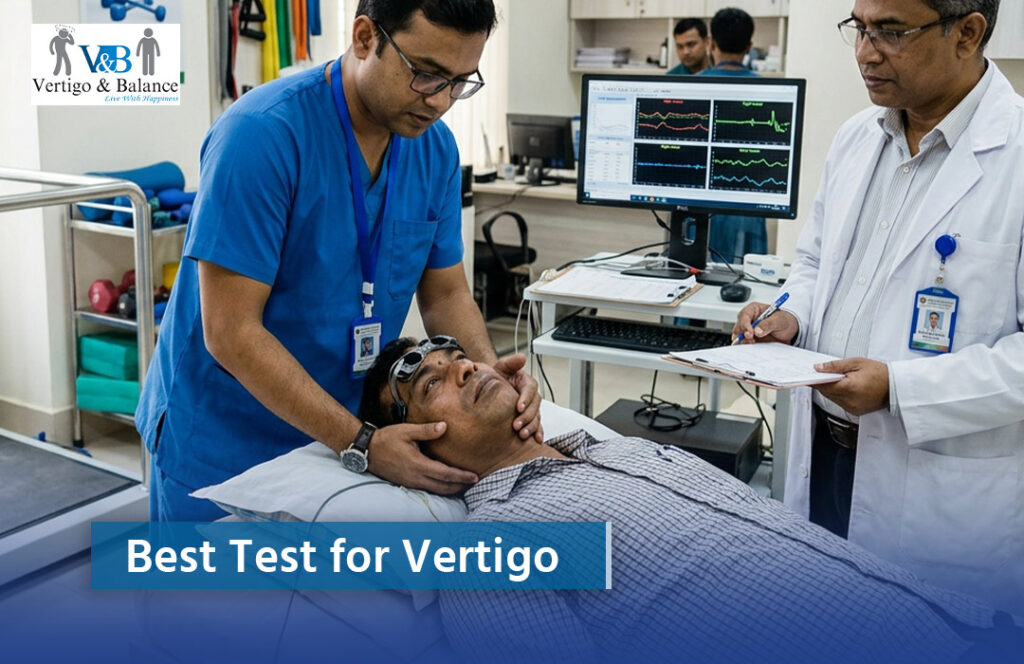
The Dix-Hallpike test is the single most widely used and most reliable test for Benign Paroxysmal Positional Vertigo (BPPV) — the most common cause of vertigo overall. In this test, the doctor moves the patient’s head and body through specific positions while watching the eyes for a distinctive pattern of movement called nystagmus.
- Quick to perform (usually under 2 minutes)
- No equipment required in its basic form
- Confirms which inner ear canal is affected
If BPPV is confirmed, treatment is often immediate. Many clinics, including ours, follow up a positive Dix-Hallpike result with the Epley maneuver, which repositions the displaced inner ear crystals and can resolve symptoms in a single session.
2. Videonystagmography (VNG) / Electronystagmography (ENG)
VNG (and its older counterpart ENG) is considered the most comprehensive vestibular test available. Small goggles with infrared cameras track eye movements while the patient undergoes a series of visual and positional tasks. It can detect:
- Which inner ear (left or right) is the source of the problem
- Whether the issue is peripheral (inner ear) or central (brain-related)
- Abnormal eye-tracking patterns linked to vestibular disorders
This test is especially useful when symptoms are unclear, recurring, or don’t respond to basic maneuvers.
3. Caloric Testing
Often performed as part of a VNG battery, caloric testing involves gently introducing warm and cool air or water into the ear canal to stimulate the vestibular system. The resulting eye movements reveal whether one ear is weaker than the other — a key sign in conditions like vestibular neuritis or Meniere’s disease.
4. Vestibular Evoked Myogenic Potentials (VEMP)
VEMP testing measures how certain neck and eye muscles respond to sound stimulation, helping assess the function of the saccule and utricle — two balance organs not evaluated by standard caloric testing. This is particularly useful for diagnosing conditions like superior canal dehiscence syndrome and some forms of Meniere’s disease.
5. Posturography (Balance Platform Test)
Also called Computerized Dynamic Posturography (CDP), this test has the patient stand on a special platform that measures sway and stability under different visual and sensory conditions. It’s especially valuable for:
- Assessing fall risk, particularly in older adults
- Measuring how well the brain compensates for balance problems
- Tracking improvement during Balance Retraining Therapy
6. Rotary Chair Testing
The rotary chair test evaluates how well the vestibular system and eyes work together across a range of head movement speeds — something caloric testing alone can’t fully capture. It’s often used for patients with chronic, ongoing balance issues rather than sudden, short episodes.
7. Romberg and Fukuda Stepping Test
These are simple, low-tech screening tests often used as a first step in a clinical exam. The Romberg test checks balance with eyes open versus closed, while the Fukuda test has the patient march in place with eyes closed to detect asymmetry in vestibular function. They’re not diagnostic on their own but help guide which advanced test to order next.
8. Blood Pressure and Cardiovascular Screening
Not all dizziness is vestibular. Orthostatic hypotension (a drop in blood pressure on standing) and other cardiovascular issues can mimic vertigo. A proper workup always includes blood pressure checks in different positions to rule this out before assuming an inner-ear cause.
9. MRI and CT Imaging
When symptoms suggest a possible central cause — such as sudden severe imbalance, slurred speech, double vision, or numbness alongside the dizziness — imaging of the brain becomes essential to rule out stroke, tumors, or multiple sclerosis. This is not a routine first test, but it’s a critical one when warning signs are present.
Which Test Do You Actually Need?
| Symptom Pattern | Likely Test |
|---|---|
| Spinning triggered by rolling over in bed or looking up | Dix-Hallpike Test |
| Recurring vertigo with unclear pattern | VNG/ENG |
| Vertigo with hearing loss or ringing in the ear | Caloric Test + VEMP |
| Unsteadiness and fall risk, especially in older adults | Posturography |
| Sudden vertigo with neurological symptoms (slurred speech, weakness) | MRI/CT (urgent) |
| Dizziness only when standing up quickly | Blood pressure screening |
If you’re unsure which category you fall into, it’s worth reading about common causes and symptoms of dizziness in Dhaka before your appointment, so you can describe your symptoms as precisely as possible — timing, triggers, and duration all help the doctor choose the right test faster.
Vertigo Testing Isn’t Just for Adults
Vertigo and balance complaints in children are often overlooked or mistaken for clumsiness or attention issues. If your child complains of spinning sensations, unsteady walking, or sudden falls, the same category of testing applies, just adapted to be child-friendly. You can read more in our guide on vertigo in children and when to worry.
Lifestyle Factors That Can Affect Test Results
Certain everyday habits can influence vestibular symptoms and even skew test results if not accounted for beforehand. For instance, some patients are surprised to learn that coffee and tea can worsen dizziness in sensitive individuals. Clinics will often advise cutting back on caffeine, alcohol, and certain medications for a short period before testing, to get the clearest possible picture of what’s really going on.
What Happens After Testing?
Testing is only useful if it leads to the right treatment. Depending on the results, your care plan may include:
- The Epley maneuver for confirmed BPPV
- Vestibular Rehabilitation Therapy (VRT) to retrain the brain’s balance response
- Balance Retraining Therapy for longer-term stability and fall prevention
- Medication or referral if the cause turns out to be cardiovascular or neurological
This is why testing shouldn’t be skipped, even if symptoms seem to go away on their own — untreated vertigo has a high chance of returning, and recurring episodes increase the risk of falls and injury.
Getting Tested in Dhaka
Vertigo Balance is a specialized clinic in Dhaka led by Dr. Sajib Saha, offering advanced vestibular testing alongside personalized, evidence-based treatment plans. From the initial Dix-Hallpike screening to full VNG evaluation and follow-up therapy, every step is designed around an accurate diagnosis first.
If you’ve been living with unexplained dizziness, don’t wait for it to resolve on its own. Contact our clinical team to book an evaluation, or visit our homepage to learn more about our services.
Frequently Asked Questions
Is there one single “best” test for vertigo? Not exactly — the best test depends on your symptoms. The Dix-Hallpike test is the standard first step for most patients, but a full VNG evaluation may follow if the cause isn’t immediately clear.
Do vertigo tests hurt? No. Most vestibular tests are non-invasive. Some, like caloric testing, can briefly trigger mild dizziness during the test itself, but this passes quickly.
How long does a full vertigo workup take? A basic clinical exam with Dix-Hallpike testing can take under 30 minutes. A comprehensive VNG or posturography evaluation typically takes 45–90 minutes.
Can I get tested without a referral? Most vestibular specialty clinics, including ours, accept direct appointments without needing a referral first.
This article is for informational purposes only and is not a substitute for professional medical evaluation. If you’re experiencing dizziness or balance issues, please consult a qualified healthcare provider.