
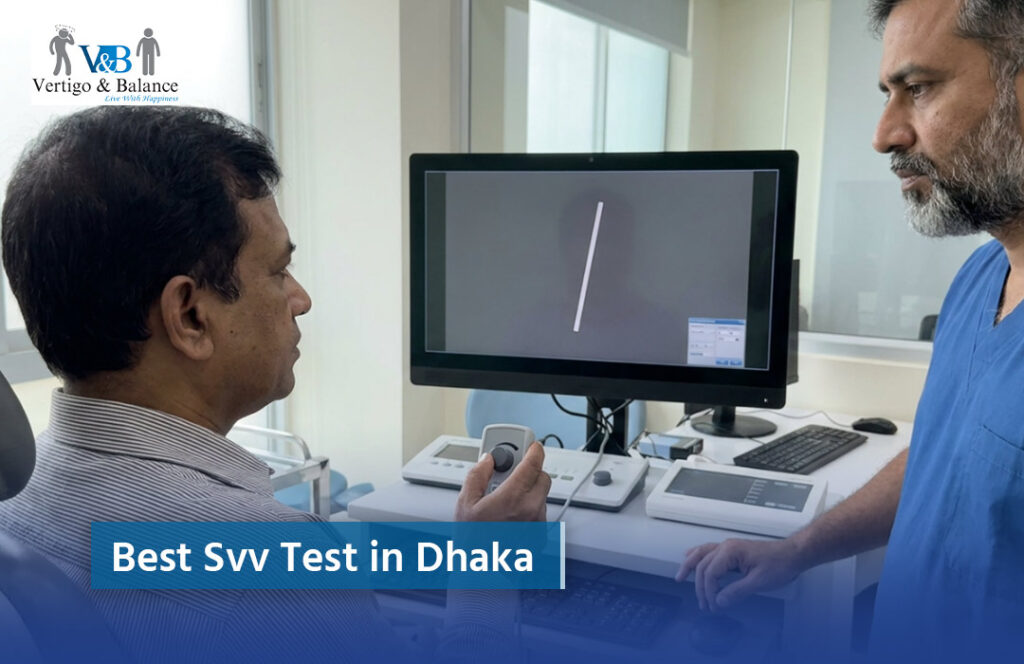
Best SVV Test in Dhaka
Some patients with vertigo or balance disorders describe a strange but specific symptom: a sense that the world, or their own body, is subtly tilted, even when everything around them looks perfectly upright to others. This particular sensation is closely linked to a part of the inner ear responsible for detecting gravity and spatial orientation, and it can be objectively measured using the SVV test. If you are searching for the best SVV test in Dhaka, this guide explains what the test evaluates, why it matters, and how Vertigo Balance, led by Dr. Sajib Saha, provides accurate, specialist-led testing.
What Is the SVV Test
SVV stands for Subjective Visual Vertical. It is a diagnostic test that measures a person’s perception of what is truly vertical, or upright, in the absence of visual reference points. During the test, the patient is asked to adjust a visible line, often a laser line or a line displayed inside a testing goggle, so that it appears perfectly vertical, aligned with true gravity. In a person with normal vestibular function, this perceived vertical line typically falls within a very small margin, generally within about two degrees, of the true gravitational vertical. A noticeable tilt beyond this margin can indicate a problem in the part of the inner ear responsible for sensing gravity and spatial orientation.
The Role of the Utricle in the SVV Test
The SVV test primarily evaluates the function of the utricle, one of two otolith organs located in the inner ear, alongside the saccule. The utricle plays a key role in detecting linear acceleration and gravitational pull, helping the brain understand the head’s orientation in space. When the utricle on one side is not functioning properly, often due to inner ear disease, vestibular neuritis, or other vestibular disorders, the brain’s perception of true vertical can become skewed, causing the patient to perceive a tilt even when none exists in reality.
Why the SVV Test Matters
Many vestibular conditions cause a subtle but measurable disruption in spatial orientation that a patient may struggle to describe clearly during a routine consultation. The SVV test provides an objective, quantifiable way to detect this disruption, rather than relying solely on the patient’s verbal description of feeling tilted or off-balance. This is particularly valuable for conditions where symptoms can be inconsistent or difficult to pin down through standard examination alone.
Conditions the SVV Test Can Help Evaluate
The SVV test is commonly used in the assessment of vestibular neuritis, where inflammation of the vestibular nerve on one side often produces a corresponding tilt in the perceived vertical. It is also useful in evaluating patients with vestibular migraine, since studies have shown a measurable tilt in SVV can persist even between vertigo episodes in migraine-related dizziness. Additionally, the test can help monitor a patient’s recovery and vestibular compensation following an acute vestibular event, since the degree of SVV tilt often decreases as the brain adapts and compensates for the underlying imbalance.
How the SVV Test Is Performed
During an SVV test, the patient is typically seated and, in many cases, wears a specialized goggle or is positioned in a darkened environment to remove visual reference points that could influence their judgment of vertical. The patient is then asked to adjust a luminous line, using a handheld remote or similar control, until it appears perfectly upright to them. The examiner records the degree of deviation between the patient’s perceived vertical and the true gravitational vertical across several trials, providing an average measurement used to interpret the result.
How the SVV Test Fits Into a Complete Vestibular Evaluation
At Vertigo Balance, the SVV test is generally used as part of a broader vestibular workup rather than as a standalone diagnostic tool. It is often combined with VEMP testing, which evaluates otolith organ function through a different method using sound-evoked muscle responses, and VNG, which records eye movements to assess overall vestibular system performance. You can learn more about how these tests work together in our detailed guides on the best test for dizziness and the best test for vertigo, which cover the complete range of diagnostic tools used to evaluate balance disorders.
Since some causes of dizziness are not vestibular in origin, a thorough evaluation at Vertigo Balance may also involve checking for other contributing factors. For patients whose symptoms may be linked to disrupted sleep, our guide on when a sleep test is needed explains this connection further.
Who Should Consider an SVV Test
An SVV test may be recommended for patients who describe a persistent sensation of tilting, leaning, or being off-balance even while standing or sitting upright, patients recovering from vestibular neuritis or labyrinthitis who need objective tracking of their vestibular compensation, patients with vestibular migraine experiencing unexplained imbalance between vertigo episodes, and patients whose symptoms have not been clearly explained through basic vestibular screening.
Why Choose Vertigo Balance for SVV Testing in Dhaka
Vertigo Balance is a specialized vertigo and balance disorder center in Dhaka, led by Dr. Sajib Saha, MBBS (DU), BMDC Reg A-65718, and certified by the American Institute of Balance (AIB). The center provides comprehensive evaluation and evidence-based treatment for vertigo, BPPV, vestibular migraine, Meniere’s disease, and other vestibular disorders, using advanced diagnostic testing and personalized treatment planning rather than relying on symptoms alone.
Once a diagnosis is confirmed, treatment is tailored to the specific findings. Patients diagnosed with BPPV may benefit from the approaches outlined in our guide on BPPV treatment, while patients recovering from vestibular neuritis or other causes of vestibular imbalance are often guided through our structured Balance Retraining Therapy program, which supports the brain’s natural process of vestibular compensation over time.
What to Expect During Your Visit
Your visit to Vertigo Balance begins with a detailed review of your symptoms and medical history. Based on this evaluation, Dr. Saha determines which specific tests, potentially including SVV, VEMP, or VNG, are most relevant to confirming your diagnosis. After testing, results are explained clearly, and a personalized treatment plan is developed based on the confirmed underlying cause rather than a generic approach.
Clinic Location and Contact
Vertigo Balance is located at 68-69 Concept Tower, 3rd Floor, Room 337, Green Road, Dhaka-1205. Appointments can be booked by calling 01915 886655 or 01915 443366.
Book Your SVV Test and Vestibular Evaluation Today
A persistent feeling of tilting or being off-balance deserves a proper explanation rather than being dismissed or left undiagnosed. The SVV test, combined with a complete vestibular evaluation, offers an objective way to identify the underlying cause of this sensation and move forward with a targeted, effective treatment plan.
Visit our Appointment page or call our clinic today to schedule your SVV test and vestibular evaluation with Dr. Sajib Saha at Vertigo Balance in Dhaka.
This content is intended for general educational purposes and does not replace a professional medical evaluation. Please consult Dr. Sajib Saha or a qualified specialist for an accurate diagnosis of your specific symptoms.